Margin Notes as a Second Draft of the Page
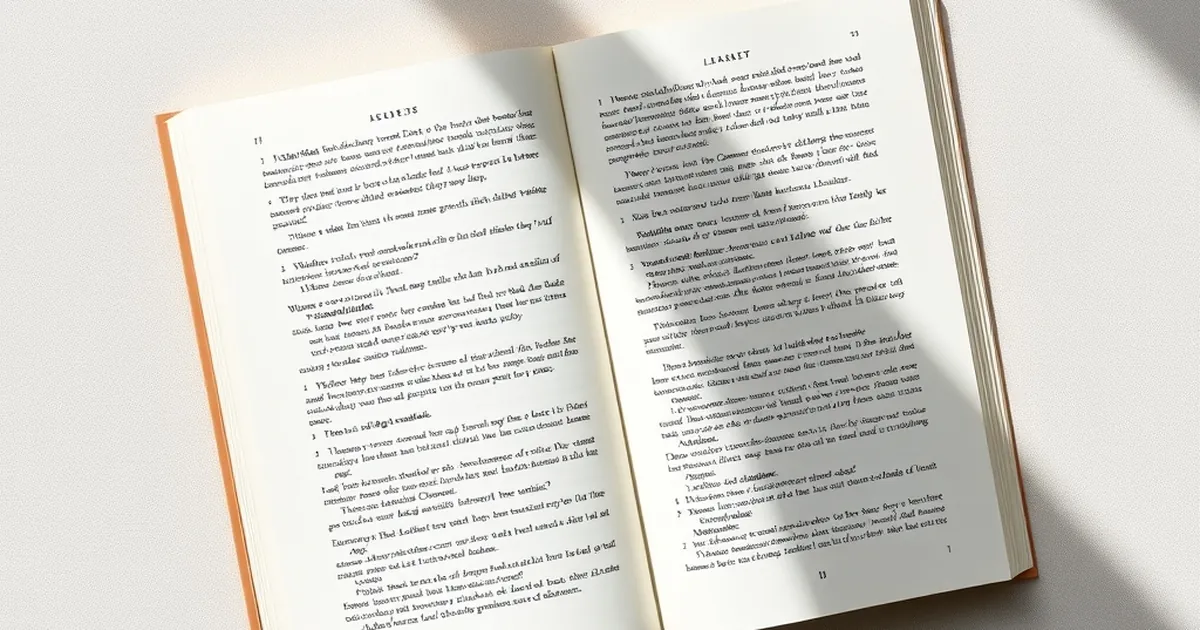
The question is not whether we write in our books, but whether we are willing to treat the act of reading as a conversation rather than a monologue. Most readers approach the page as a finished object, a monument to be admired, but the margin is where the monument starts to crumble and rebuild itself in your own image. What if we considered the scribbled notes, the underlines, and the question marks not as defacement, but as the first authentic draft of our intellectual response to a text?
The Cartography of Thought
To write in a margin is to draw a map of your own mind as it moves through someone else’s territory. The blank space surrounding the printed text is not merely a border; it is a field of potential energy where the author’s authority meets your own cognitive friction. When you interact with a page, you are not just recording what you think—you are discovering what you think, which is a fundamentally different process.
This distinction is crucial for the academic reader. A highlighter is a passive tool; it marks what is already there. A pen, however, is an active instrument; it forces you to translate the author’s syntax into your own shorthand. This act of translation is the genesis of the "second draft" concept. The printed page is the first draft of the author’s idea; your marginalia is the second draft of that page as it exists in your specific context.
The Index of the Self
Consider the psychology of the margin. When you write "This reminds me of Foucault" next to a passage on power, you are not just making a connection; you are indexing your own intellectual history. Over time, the margins of a well-read book become a palimpsest of your past selves. You can see where you were, intellectually, when you first read the text.
This is why the pristine book is often a sign of a passive reader. The scholar who keeps their books clean may be preserving the object, but they are also erasing the evidence of their own cognitive journey. The margin note is a timestamp, a record of a specific moment of insight that can never be replicated. It is the difference between viewing a landscape through a window and stepping out to walk the terrain.
The Dialogue of Annotations
The margin is also a space for argumentation. The author proposes; the reader disposes. When you write "This is a logical fallacy" or "Yes, but what about X?" in the margin, you are engaging in a high-stakes debate with a partner who cannot respond. This asymmetry is what makes the practice so intellectually rigorous; you are forced to anticipate counter-arguments without any feedback.
This creates a specific kind of critical thinking that is hard to replicate in a purely digital format. The physical act of writing slows down your processing, forcing you to articulate a response that is more than a mere emotional reaction. You are building a case against the text, or for it, in a space that is simultaneously public (the printed word) and private (your handwriting).
The Economics of Attention
There is a distinct economic principle at play here: marginalia forces you to spend your attention wisely. You cannot annotate every sentence, so you are forced to decide what is worth the ink. This selection process is a meta-cognitive exercise—you are constantly evaluating the value of the information against the cost of your engagement with it.
This is where the "second draft" metaphor becomes most potent. The author wrote the book to be read linearly; you are rewriting it to be read strategically. Your notes create a new architecture for the text, highlighting the load-bearing walls and ignoring the decorative trim. This allows you to return to the book later and read your own condensed version, which is often more valuable than the original.
The Annotated Object as a Relic
There is a specific, almost tactile pleasure in the physical artifact of a heavily annotated book. The crease in the spine, the smudge of graphite, the dog-eared corner—these are the scars of a life lived with the text. For a global audience, this practice transcends cultural boundaries because it speaks to the universal human desire to leave a mark on what we encounter.
In many academic traditions, the annotated book is a sign of respect, not of vandalism. It shows that the reader took the work seriously enough to wrestle with it. I recall a colleague who owned a battered copy of a post-colonial theory text; the margins were so dense with notes that they spilled onto the flyleaf. When asked about it, he said, "The book is not the text; the book is the record of my reading of the text." That object was irreplaceable—not because of the author’s words, but because of the layered readings inscribed upon them.
The Digital Counterpoint
We must acknowledge the elephant in the room: the e-reader and the PDF highlighter. Digital annotation is efficient, searchable, and clean. But it often lacks the permanence and the physical friction of the ink-on-paper approach. A digital highlight is easily deleted; a pen stroke is a commitment.
However, the digital space offers a different kind of second draft—one that is collaborative. Tools that allow for shared annotations create a "third draft" of the text, one that is written by a community. But for the individual pursuit of knowledge, the physical margin remains the most direct line to your own cognitive processes. The point is not to choose one over the other, but to understand that the intent to annotate is more critical than the tool you use.
A Practical Takeaway for the Active Reader
The next time you pick up a book, do not be afraid to disagree with it. Pick up a pen and start a fight. The goal is not to fill every blank space, but to make every mark count. Start by asking a single question of the text and forcing yourself to answer it in the margin.
Look forward to the moment when you return to that book in five years. You will not be reading the author’s words alone; you will be reading a conversation between your past self and the author, a dialogue that is now part of the text’s history. That is the true value of the margin note—it is not a summary of the page, but an argument with it. And that argument is the only draft of your own thinking that you will ever get to keep.